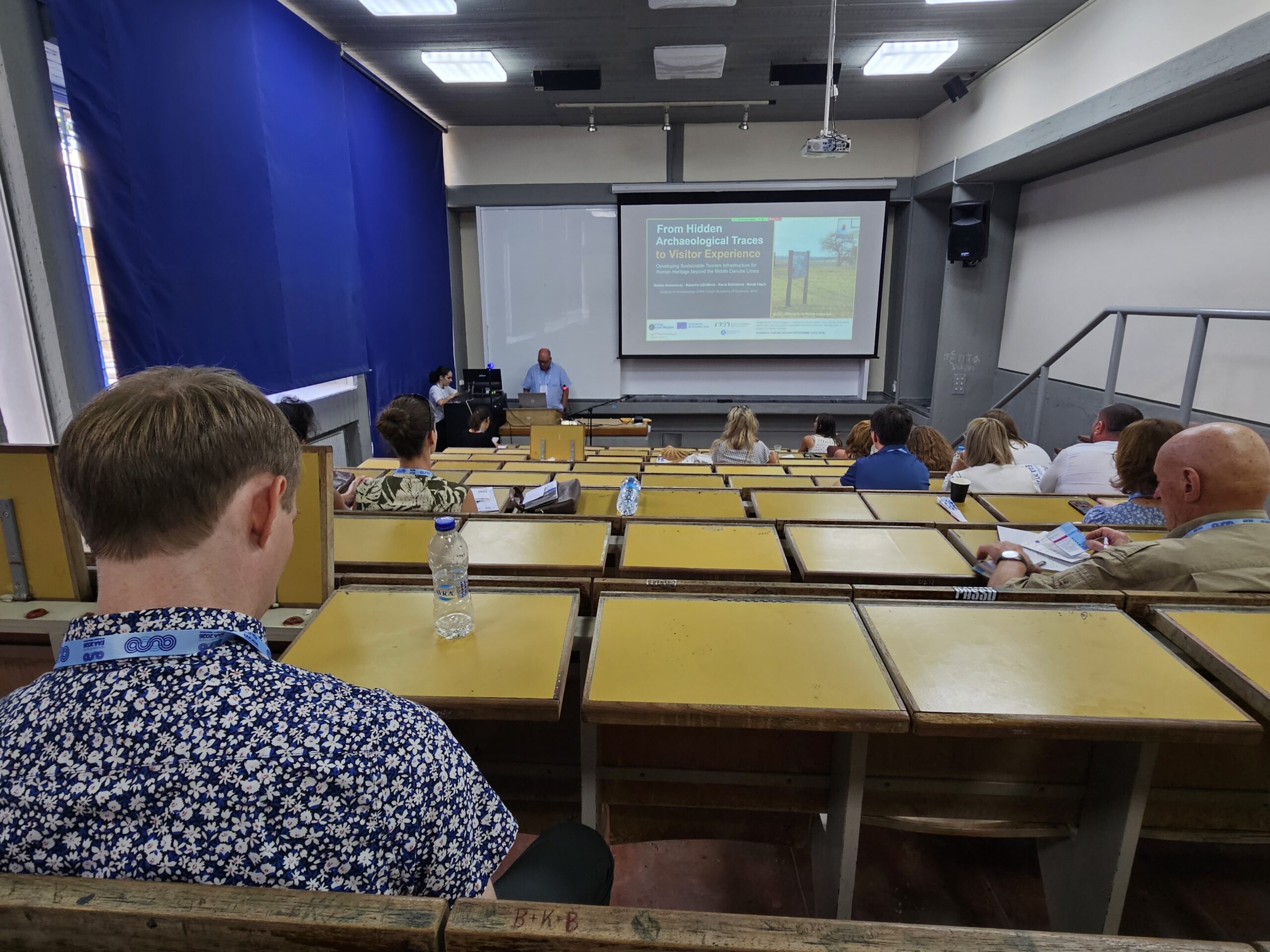
Representatives of the Institute of Archaeology of the Czech Academy of Sciences, Brno participated in the 32nd Annual Meeting of the European Association of Archaeologists (EAA 2026), held in Athens, Greece. They shared their experience of bringing the results of long-term research into the Roman presence north of the Middle Danube to the public and using this knowledge to develop sustainable cultural tourism.
Their contribution formed part of session #212, Transforming Data into Experience: Interdisciplinary Strategies for Sustainable Archaeological Tourism, which focused on connecting archaeological research with visitor experiences. The session was organised by Roman Legacy project team members Marta Rakvin and Jacqueline Balen from Croatia, Szilvia Fábián from Hungary, and Sarah Kiszter and Raffaela Woller from Austria. Discussions centred on interdisciplinary and international collaboration in interpreting archaeological heritage and making it accessible to visitors.
Balázs Komoróczy, Katarína Liščáková, Pavla Růžičková and Marek Vlach presented the contribution From Hidden Archaeological Traces to Visitor Experience: Developing Sustainable Tourism Infrastructure for Roman Heritage beyond the Middle Danube Limes. They explored how to introduce the public to archaeological sites whose significance is demonstrated by rich finds and research evidence, but which often have no visible remains in the landscape.
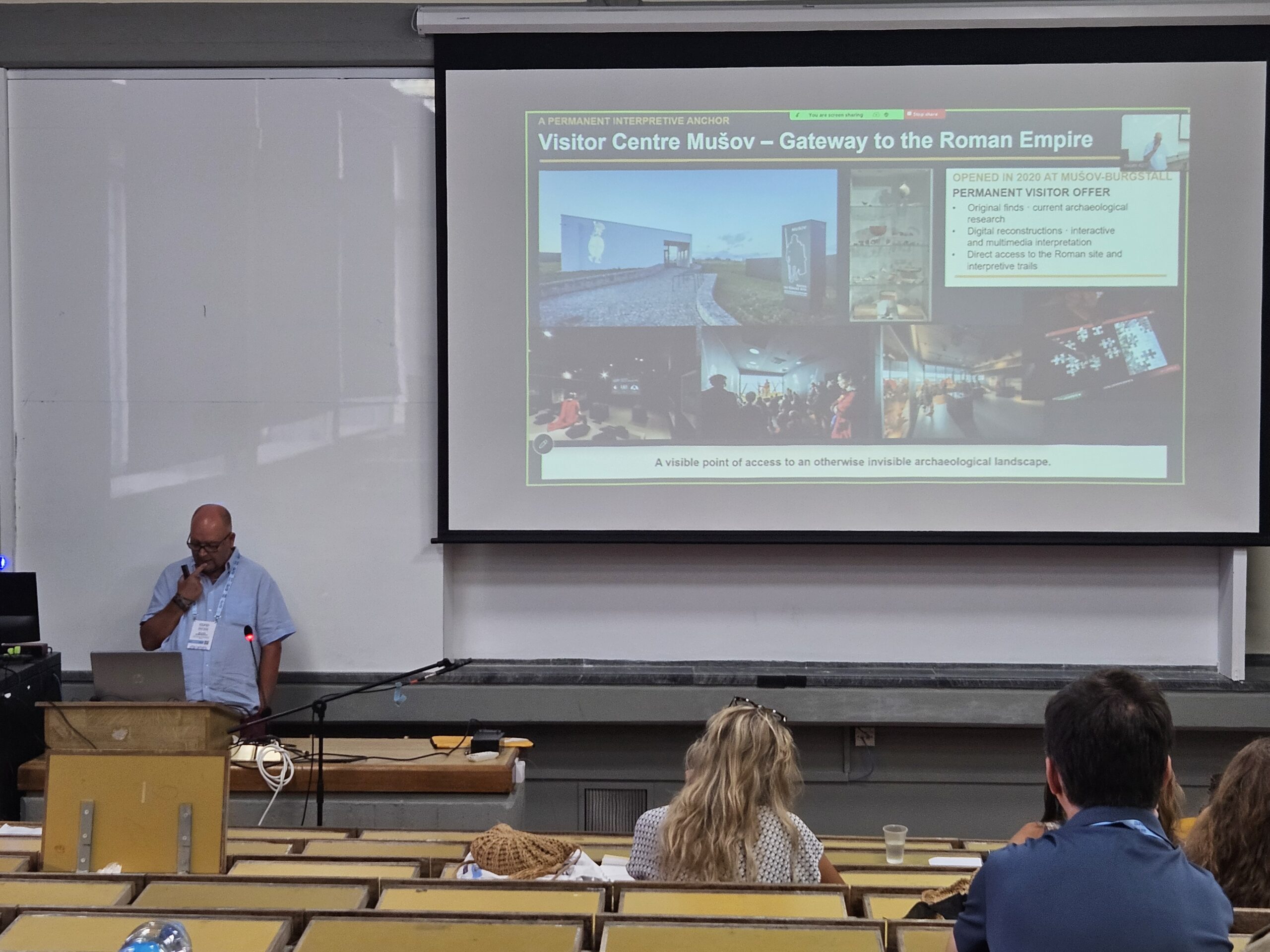
Drawing on research into the Roman military presence and Roman-Germanic relations, the authors traced the gradual development of public interpretation of this heritage: from a museum exhibition and the first interpretive trails to the establishment of the Visitor Centre Mušov – Gateway to the Roman Empire, followed by digital tools, educational activities and public programmes. They emphasised the connection between the visitor offer and current research, as well as opportunities for active public participation.
The presentation also introduced the Roman Trails and Roman Legacy projects, in which our institute is a partner. Roman Trails is developing a network of interpretive trails and interpretation points in South Moravia and the Weinviertel region of Lower Austria. Roman Legacy places these regional activities within the broader international framework of a theme region and cultural route along the Danube Limes. Both projects help connect individual sites and develop an accessible and sustainable visitor offer.
Participation in EAA 2026 provided an opportunity to present our institute’s work and involvement in the Roman Legacy project to an international professional audience, share experience in communicating archaeological heritage, and develop collaboration with research and heritage institutions from other European countries.